

Commercial disclosure: FansFlux and Penmowu are operated by the same owner. This guide includes commercial references to Penmowu. Provider information is based on public descriptions, not a hands-on delivery test.
Facebook video results become easier to interpret when you separate three questions: was the content displayed or played, how much attention did it receive, and what happened afterward? A single large view count cannot answer all three.
This distinction matters when comparing ordinary publishing, advertising and a third-party service. Each can produce a different reporting record. Put those records side by side without assuming that all of them measure the same thing.
Do not build a new report around an old format rule
Meta announced in June 2025 that Facebook video publishing would be unified under Reels, with a gradual rollout. That makes old blanket statements about every Reel being a particular short duration a poor foundation for a current guide. Check the actual content and reporting surface. Meta: unifying Facebook video publishing
Write down the video URL, duration, publication time and measurement window. Where Facebook offers multiple view thresholds, preserve the complete field names rather than shortening all of them to “views.”
Count attention separately from exposure
A view field is a count under a particular definition. Watch time is accumulated time. Retention describes how viewing continues through the content. These measures answer related but different questions.
For a hypothetical one-minute video, imagine 300 minutes watched across 1,000 eligible plays. That is 18 seconds per play when the two fields cover the same events: 300 × 60 ÷ 1,000. It does not establish that every viewer left at second 18.
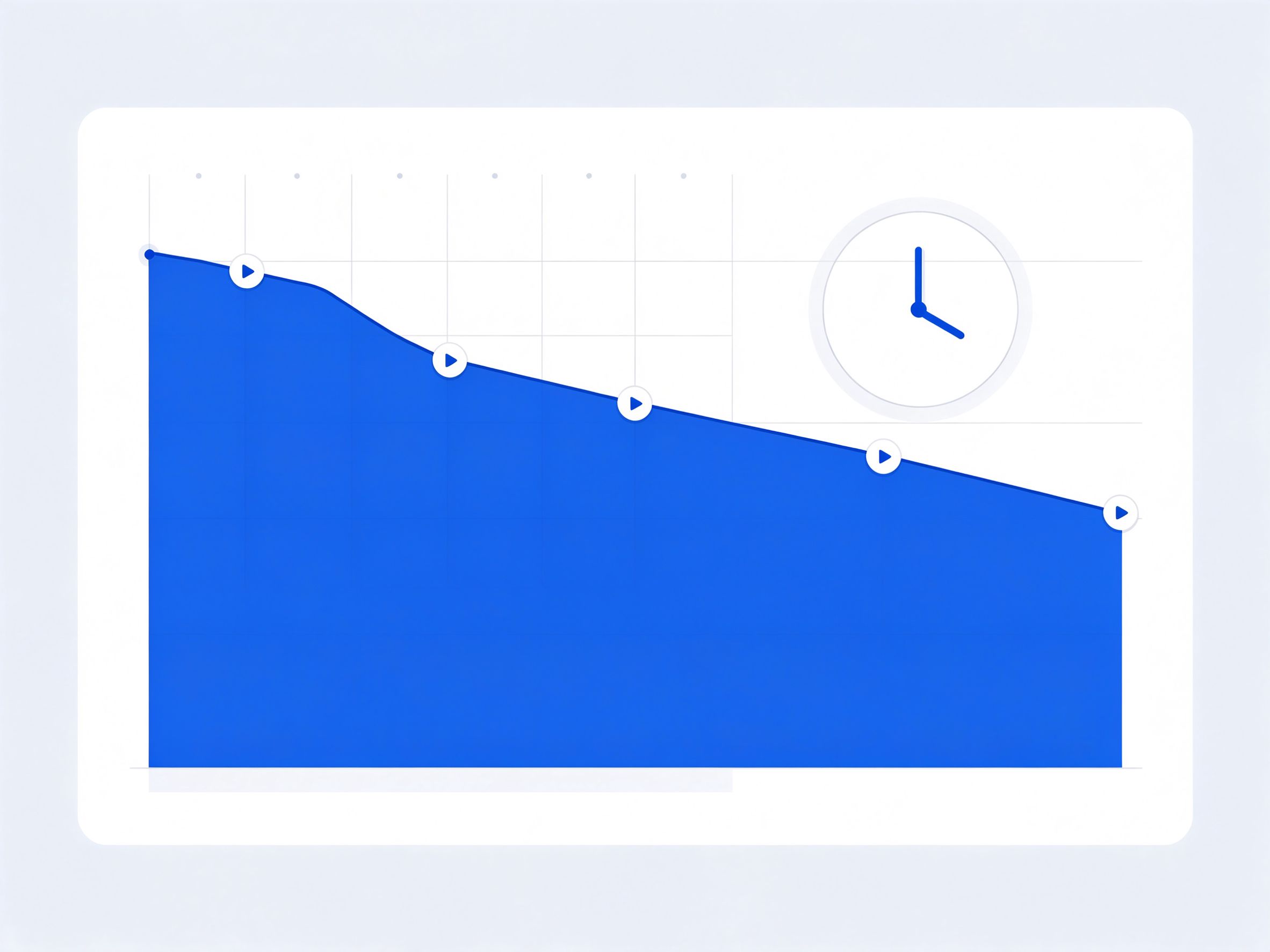
The average could combine very short sessions and complete watches. A time-based curve, where available, can reveal a pattern that a single average hides.
Compare like-for-like observation windows
A video published yesterday has had less time to accumulate activity than one published last month. Compare the first 24 hours with the first 24 hours, or the first seven days with the first seven days.
Also separate a live broadcast's live-period results from replay activity. A live audience peak, accumulated playback and the audience watching a saved version should not be added together and labeled unique attendees.
Diagnose the weak point
Consider three fictional outcomes. Video A has many starts but loses attention before the product appears. Video B holds attention but sends few people to the stated next step. Video C produces fewer views but more documented appointment requests.
The editorial fixes differ: move the demonstration earlier for A, clarify the next action for B, and test whether C's specific topic can be expanded. None of these conclusions requires declaring an arbitrary industry-wide retention benchmark.
What a purchased quantity cannot prove
When reviewing Facebook video or Reels options on Penmowu, read which object and quantity the selected entry covers. A quantity-based service is not automatically a watch-time service, a lead-generation campaign or a guarantee of recommendation. Penmowu public service catalog
Do not calculate a conversion rate using delivered quantity as the denominator unless it is genuinely the measured population for the outcome. Keep the order record separate from the platform report and from website analytics.
Use a concise decision summary
Record content topic, duration, matched observation window, exact view label, watch time, available retention information and verified next actions. Add the dates of advertisements or other promotion.
Finish with a decision that can be tested: shorten the opening, improve captions, explain the offer earlier, or repair the landing page. That turns Facebook video analytics into a production tool rather than a contest to display the largest number.